ENVRI Hub Policies

Essential Climate Variables
Taking the pulse of the Earth
The ENVRI-Hub harmonises access to ENVRIs across different Earth domains, including Atmosphere, Ecosystem & Biodiversity, Marine and Solid Earth, through a federated and seamless access to data, services and assets, under the prism of Essential Variables.
The family of Essential Variables (EVs) consists of a set of variables that allows scientists, scientific and policy makers to monitor the health of our changing planet. This family spans four interconnected domains: Climate (ECVs), Oceans (EOVs), Biodiversity (EBVs), and Geodesy (EGVs). EVs are usually delivered as global gridded datasets, and illustrated on geographical maps. To construct them, several kinds of data are merged:
- In-situ observations
- Satellite data
- Computer modeling and reanalysis
The complete family of Essential Variables, their governance, their definition and example variables are presented here-below. For more information about each framework, follow the indicated links.
| Domain | Governance | Definition | Example Variables |
|---|---|---|---|
ECV Chart
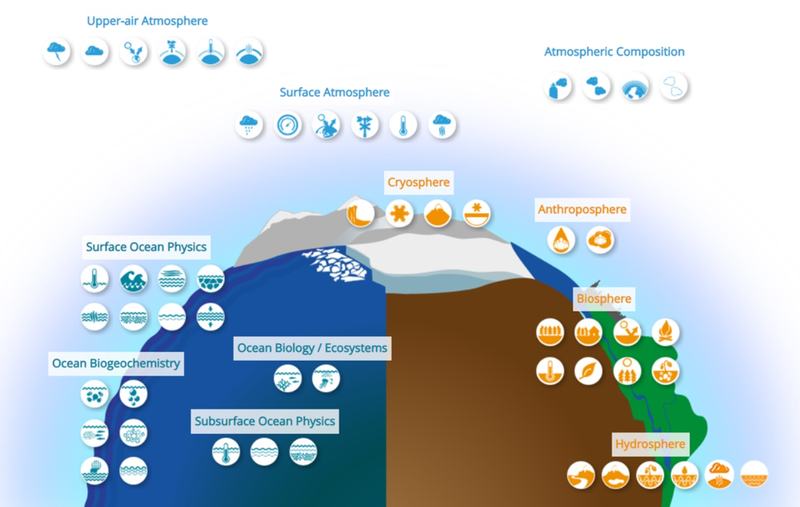
Source: GCOS Essential Climate Variables
EOV Chart
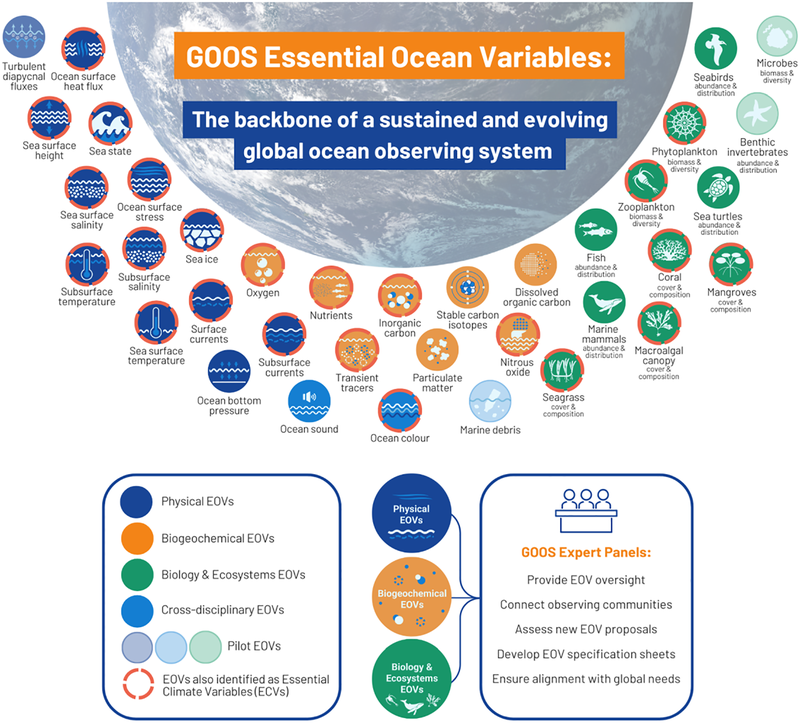
Source: GOOS Essential Ocean Variables
By collecting, processing and distributing in-situ data, Environmental Research Infrastructures provide ground-truth variables contributing to the assessment of the Essential Variables (ECVs, EOVs, EBVs, EGVs).
Together with satellite data and model outputs, they contribute to take the pulse of the Earth and predict future climate scenarios.
ENVRI-Hub harmonises access to ENVRIs across different Earth domains, including Atmosphere, Ecosystem & Biodiversity, Marine and Solid Earth, through a federated and seamless access to data, services and assets, under the prism of Essential Variables.
Harmonised vocabulary: exposing and mapping the Essential Variables
One of the hardest parts of making data reusable is semantics. If one infrastructure labels a data column “temp_sea_surf” and another labels it “SST”, a computer cannot easily combine them.
The adopted solution was to:
- web-expose a vocabulary for the Essential Variables. The NERC Vocabulary Server, managed by the British Oceanographic Data Centre, now includes an “EXV” table, where X stands for either « C », « O », « B » or « G » to reflect ECVs, EOVs, EBVs or EGVs.
- perform mapping of ENVRIs internal vocabularies to this EXV vocabulary, using what is called the I-Adopt framework. More details regarding I-Adopt here.
Searching and Filtering ENVRI assets
To look for all the research infrastructures' services that provides data contributing to a given Essential Variable, the ENVRI-Hub proposes special filtering features in its Catalogue of Services:
- additional Essential Variable filtering xfield in the Catalogue of Services (updating its dcat metadata schema)
- new functionality to the Catalogue of Services to define a preset selection of ENVRIs services granting access to variables contributing to a particular ECV: the “ECV use case” functionality